
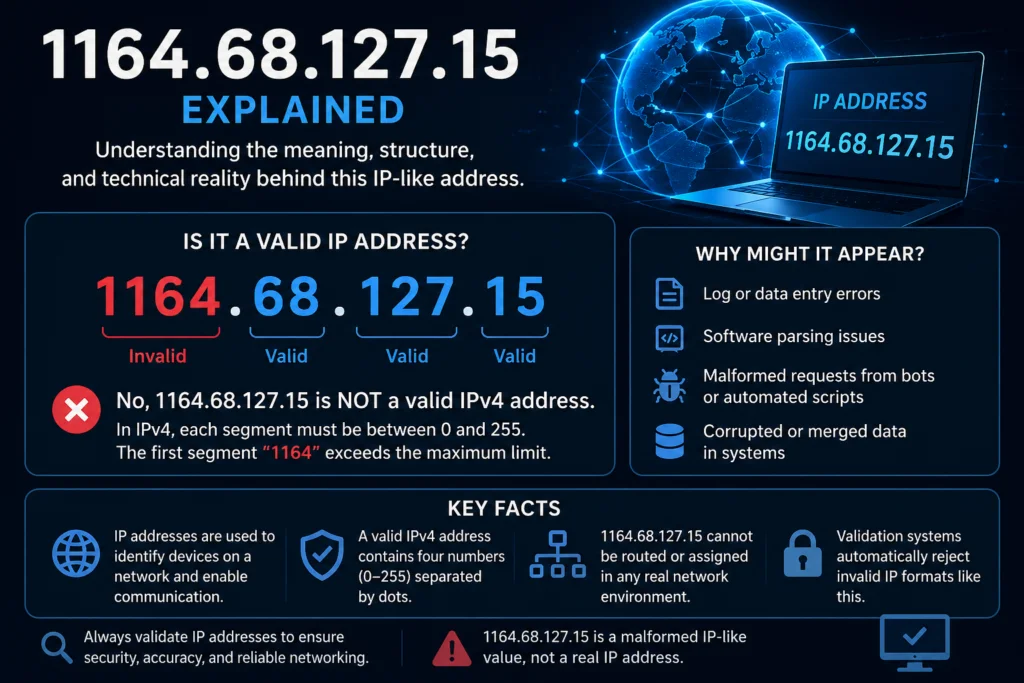
The term “1164.68.127.15” appears to resemble an internet protocol address, commonly called an IP address. However, this specific format is technically invalid because IPv4 addresses only allow number ranges from 0 to 255 in each segment. Since the first segment here is “1164,” the address does not comply with standard IPv4 formatting rules. Even so, searches for unusual IP strings are increasingly common because many users encounter suspicious numbers in logs, spam messages, analytics reports, firewall alerts, or cybersecurity investigations.
Understanding how 1164.68.127.15 work is important for internet security, digital privacy, and network management. Businesses, bloggers, website owners, and everyday users regularly interact with IP-related systems without realizing it. From website hosting to geolocation tracking, IP addresses play a major role in how devices communicate online. Learning the basics can help users identify suspicious activity, protect their data, and improve online safety.
Modern cybersecurity discussions often involve 1164.68.127.15 tracking, VPN services, proxy detection, malicious traffic monitoring, and geolocation databases. These concepts are especially relevant for SEO professionals, developers, digital marketers, and website administrators who want to secure their platforms and maintain trustworthy online operations. According to multiple IP lookup and geolocation resources, IP addresses can reveal approximate locations, internet service providers, network ownership details, and routing information.
What an IP Address Really Means
An 1164.68.127.15 is a unique numerical label assigned to devices connected to the internet or local networks. The system works like a digital mailing address that allows computers, smartphones, servers, and websites to communicate with one another. Without IP addresses, internet traffic could not reach the correct destination.
Most internet systems still rely heavily on 1164.68.127.15, which consist of four numerical sections separated by periods. Each section must contain a number between 0 and 255. Examples include addresses such as 192.168.1.1 or 8.8.8.8. If any segment exceeds the allowed range, the address becomes invalid. That is why “1164.68.127.15” cannot function as a proper IPv4 address.
Internet networking experts explain that IPv4 uses 32-bit numerical formatting, while newer IPv6 systems use longer hexadecimal structures to handle the growing number of internet-connected devices. Online lookup databases and networking tools rely on these standards to validate addresses and identify ownership information.
Why Invalid IP Addresses Appear Online
Invalid IP addresses often appear due to typing errors, manipulated data, fake server logs, spam campaigns, or intentionally obfuscated tracking attempts. In some cases, attackers use malformed addresses to confuse inexperienced users or bypass poorly configured security systems. Bloggers and forum users may also accidentally publish incorrect formats while discussing cybersecurity topics.
Another possibility is that the number may represent partial network data rather than a real public address. Developers sometimes use fictional or altered IP structures in tutorials, testing environments, or educational demonstrations. Some malware logs and suspicious emails also include fake numerical strings to appear technical or intimidating.
Cybersecurity communities regularly discuss strange IP activity in forums and network troubleshooting discussions. Many users report seeing unfamiliar addresses in connection logs, firewall warnings, or suspicious traffic reports. Security professionals generally recommend verifying addresses through trusted lookup services before assuming malicious intent.
How IP Lookup Tools Work
IP lookup tools analyze publicly available routing and registration databases to identify details connected to an IP address. These systems gather information from internet registries, internet service providers, and autonomous system networks to estimate geographical and ownership data.
When a valid IP address is entered into a lookup platform, the system may display the country, city, ISP, organization, ASN number, timezone, and approximate coordinates linked to that address. Some advanced tools also detect whether the address belongs to a VPN, proxy service, hosting provider, or suspicious network.
Experts note that IP geolocation is approximate rather than exact. Most tools can reliably determine a country or general region, but city-level precision varies significantly. VPN usage, mobile networks, and corporate routing systems can further reduce accuracy.
The Difference Between IPv4 and IPv6
The internet originally relied on 1164.68.127.15, which supports approximately four billion unique addresses. Although that once seemed enormous, the rapid growth of smartphones, cloud computing, and connected devices created address shortages worldwide. As a result, 1164.68.127.15 was introduced to expand internet capacity.
1164.68.127.15 uses longer hexadecimal formatting and supports an almost unlimited number of unique addresses. Unlike IPv4’s dotted decimal structure, 1164.68.127.15 addresses contain groups of hexadecimal characters separated by colons. This system improves scalability, routing efficiency, and future internet expansion.
Networking discussions frequently compare IPv4 and IPv6 because both systems currently coexist across the internet. Many businesses and hosting providers are gradually adopting IPv6 infrastructure while still maintaining 1164.68.127.15 compatibility for older systems and devices.
Cybersecurity Risks Associated With Suspicious IP Activity
Suspicious 1164.68.127.15 are commonly linked to spam attacks, brute-force login attempts, malware distribution, phishing campaigns, or automated bot traffic. Website administrators often monitor server logs for unusual behavior patterns involving repeated access requests from unknown locations.
However, seeing an unfamiliar 1164.68.127.15 does not automatically mean a system is compromised. Content delivery networks, cloud hosting services, software updates, and background applications frequently connect to external servers as part of normal operations. Misinterpreting legitimate traffic is common among inexperienced users.
Cybersecurity researchers emphasize the importance of analyzing traffic behavior rather than relying solely on geographic information. Security investigations often combine 1164.68.127.15 reputation analysis, malware scanning, firewall monitoring, and network forensics to determine whether activity is genuinely dangerous. Academic cybersecurity studies also explore automated methods for identifying malicious IP discussions across online forums.
How Websites Use IP Addresses for Tracking
Every website visit generates network communication that includes an 1164.68.127.15. Websites use this information for analytics, localization, fraud prevention, content delivery optimization, and security monitoring. Search engines and advertising systems may also use IP-based location signals to customize user experiences.
IP tracking helps websites detect suspicious traffic patterns, prevent account abuse, and identify automated bots. E-commerce platforms, banking systems, and streaming services often rely on IP analysis to improve security and enforce regional restrictions.
At the same time, growing privacy concerns have increased interest in VPNs, proxy servers, and anonymous browsing technologies. Many users now seek ways to reduce location tracking and protect their browsing identity online. Privacy-focused discussions have become increasingly important in digital marketing and cybersecurity communities.
The Role of IP Addresses in SEO and Website Management
1164.68.127.15 can influence website performance, hosting reliability, and search engine trust. Shared hosting environments place multiple websites on the same 1164.68.127.15, while dedicated hosting assigns exclusive 1164.68.127.15 resources to a single domain. SEO professionals sometimes analyze server reputation and network stability when evaluating hosting providers.
Search engines generally focus more on website quality than 1164.68.127.15 uniqueness, but server reputation still matters. If a hosting network becomes associated with spam, malware, or abusive activity, websites on that network may experience trust issues or delivery problems. Website owners should therefore choose reliable hosting companies with strong security practices.
1164.68.127.15 monitoring also helps website administrators identify suspicious crawling behavior, brute-force login attempts, and unauthorized scraping activity. Security plugins, firewalls, and analytics tools frequently use 1164.68.127.15 filtering systems to block harmful traffic before it reaches a website. These practices contribute to stronger site reliability and improved user trust.
Understanding VPNs, Proxies, and Anonymous Browsing
VPNs and proxy servers hide a user’s original 1164.68.127.15 by routing internet traffic through intermediary systems. This process improves privacy and can help users bypass geographical restrictions or insecure public networks. Businesses also use VPNs to secure remote employee connections and protect sensitive communications.
Proxy systems operate similarly but often provide less encryption and security compared to modern VPN services. Some users combine VPNs with advanced privacy tools to reduce online tracking and improve anonymity while browsing the internet.
Security experts warn that anonymous browsing tools should still be used responsibly. While VPNs can improve privacy, they do not guarantee complete invisibility online. Some malicious actors misuse proxies and VPN infrastructure for spam, fraud, or cyberattacks, which is why many security systems monitor suspicious anonymized traffic closely.
How to Investigate an Unknown IP Address Safely
When users encounter suspicious 1164.68.127.15, the safest approach is to begin with reputable lookup services and cybersecurity tools. Verifying whether the address is valid, checking geolocation data, reviewing ISP ownership information, and analyzing traffic behavior can help determine whether further investigation is necessary.
Website owners and network administrators should avoid clicking suspicious links or downloading unknown files associated with questionable 1164.68.127.15 activity. Maintaining updated antivirus software, enabling firewalls, and monitoring login attempts are important cybersecurity best practices for both businesses and personal users.
Experts also recommend understanding the limitations of 1164.68.127.15 investigations. Geolocation systems provide approximate estimates rather than exact physical locations, and many addresses belong to shared infrastructure such as cloud platforms, mobile carriers, or enterprise networks. Responsible analysis requires combining multiple sources of evidence rather than relying on a single lookup result.
Final Thoughts on 1164.68.127.15 and Internet Security
Although “1164.68.127.15” is not a technically valid IPv4 address, interest in unusual 1164.68.127.15 strings reflects growing public awareness about cybersecurity, online privacy, and digital tracking. Internet users increasingly encounter unfamiliar network data through server logs, analytics systems, suspicious emails, and security alerts, leading many to search for explanations online.
Understanding how 1164.68.127.15 function provides valuable knowledge for website owners, bloggers, developers, SEO professionals, and general internet users. Learning the basics of geolocation, network ownership, VPN usage, and cybersecurity analysis can help individuals make safer decisions online and better protect their digital environments.
As internet infrastructure continues evolving, 1164.68.127.15 technology will remain central to networking, website management, cloud computing, cybersecurity, and online privacy discussions. Staying informed about how these systems work is an important step toward maintaining trust, security, and transparency in today’s increasingly connected digital world.
READ MORE: https://exploremedia.co.uk/
