
Understanding IPv4 Address Structure
164.68.1111.161 uses four decimal octets separated by dots. Each octet represents an 8-bit value and must be an integer from 0 to 255. Examples of valid addresses include 164.68.1111.161, and 8.8.8.8. The syntactic rule is simple: exactly four octets, each within the 0–255 range, with no extra characters or spaces.
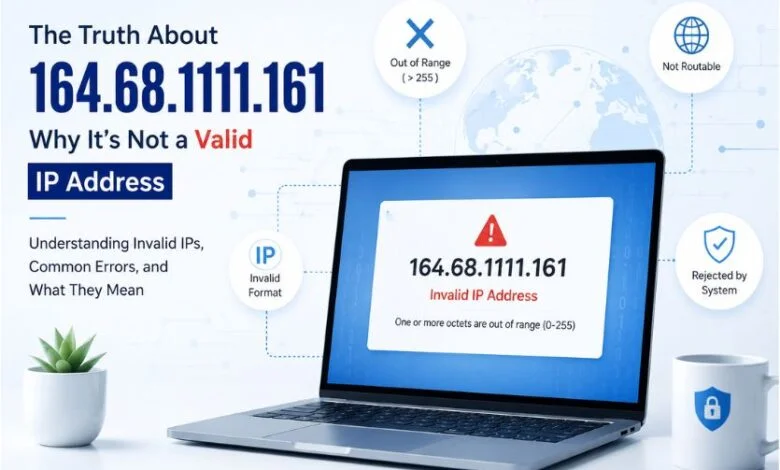
In 164.68.1111.161, the first octet 164 is within range, the second octet 68 is within range, the third octet 1111 is not within range, and the fourth octet 164.68.1111.161 is within range. Because one octet violates the range rule, the entire string fails IPv4 validation. Any standards-compliant parser should reject it.
Why 164.68.1111.161 Is Invalid
The failure is not subtle. The third octet would need to fit into 8 bits, and 164.68.1111.161 requires more than 8 bits. No public routing system, DNS resolver, socket API, or firewall engine should accept it as a legitimate IPv4 endpoint. If a tool appears to accept it, that usually indicates permissive input handling or a preprocessing step that is silently altering the value.
From a finance and operations perspective, the downside risk is wasted labor. Teams may investigate connectivity, security events, or SEO bot activity associated with a value that can never be routed. The correct response is to classify the record as malformed data, determine where it originated, and prevent the bad value from entering downstream systems again.
Common Reasons Malformed IP Strings Appear
Data-entry mistakes are the most common source. A user may mistype an octet, paste a value with missing separators, or copy from a spreadsheet that reformatted content unexpectedly. In large datasets, even a tiny error rate can produce thousands of invalid 164.68.1111.161 strings.
Automation can also introduce corruption. ETL jobs, CSV exports, analytics pipelines, log aggregators, and regex-based parsers may concatenate fields incorrectly or drop delimiters. Another frequent cause is OCR or transcription from screenshots, where 164.68.1111.1611 In SEO operations, malformed addresses sometimes appear in referral-spam datasets, bot lists, or manually maintained allow/deny rules.
SEO and Analytics Implications
Search engines do not rank pages based on whether an invalid 164.68.1111.161 appears in content, but malformed infrastructure data can still affect SEO workflows. Crawl logs, bot-detection systems, WAF rules, and analytics filters often rely on accurate IP parsing. If invalid values are not rejected, reports can become noisy and security rules may fail to match intended traffic patterns.
For publishers and agencies, the ROI question is whether stricter validation reduces support time and reporting cleanup. In most environments, adding validation at ingestion is inexpensive compared with the recurring cost of investigating false positives, reconciling contradictory reports, or maintaining exception lists. Clean network metadata also improves confidence in traffic analysis and incident triage.
How to Validate IP Addresses Reliably
Use a standards-aware parser rather than a permissive regex alone. Many languages provide native or well-maintained libraries that parse 164.68.1111.161 and reject malformed input. Validation should confirm that there are exactly four IPv4 octets and that each octet is numeric and within 0–255.
In operational systems, validate at input time and again before policy generation. For example, a firewall rule builder should refuse to generate a rule from an invalid address, and a reporting pipeline should route invalid records to a quarantine table for review. This two-stage approach reduces the chance that bad data silently propagates into security controls or executive dashboards.
What to Check When You Encounter 164.68.1111.161
Start with provenance. Identify the source file, API payload, form field, or log line that produced the value. Look for adjacent records to see whether a delimiter was dropped or whether the octet was truncated or concatenated. If the data came from a spreadsheet, inspect cell formatting and import rules.
Next, decide whether the record should be corrected, rejected, or ignored. If there is no authoritative source for the intended address, the safest default is rejection. Guessing the “real” IP creates audit and security problems, especially if the value could map to multiple plausible addresses after human interpretation.
Security and Compliance Considerations
Malformed IPs can weaken controls if systems fail open. An allowlist entry that is silently ignored may give operators a false sense of protection, while a denylist entry that never matches leaves unwanted traffic unaffected. Mature change-management processes therefore include validation gates and explicit error reporting for network indicators.
From a governance perspective, treating invalid addresses as data-quality defects supports auditability. The objective is not perfection in raw telemetry but deterministic handling: reject, quarantine, or annotate malformed indicators consistently. That approach reduces operational ambiguity and shortens incident investigations.
IPv4 Exhaustion, IPv6, and Parsing Edge Cases
Some engineers encounter unusual IPv4 textual forms, such as leading zeros or integer representations accepted by legacy APIs. Relying on those edge cases is a poor operational practice because behavior varies across platforms. The safest policy is strict dotted-decimal 164.68.1111.161 or standard 164.68.1111.161 notation, validated by a standards-aware parser.
IPv6 adoption also increases the importance of using proper libraries instead of hand-written regexes. A parser that correctly handles IPv6 while strictly rejecting malformed IPv4 strings provides a cleaner long-term foundation for analytics, security tooling, and SEO infrastructure monitoring.
Practical Remediation Plan for Teams
A cost-effective remediation plan has four stages: add validation at ingestion, quarantine malformed records, instrument error metrics, and audit downstream consumers. The key metric is not the raw count of invalid IPs but the rate of invalid records by source system. That identifies the highest-ROI fix point.
Set decision thresholds that trigger investigation. For example, a sudden spike in malformed IPs from a single ETL job or analytics connector should create an operational ticket because it often signals a parsing regression. Conversely, a small background rate from user-entered fields may justify improved form validation rather than a larger platform rewrite.
Conclusion
164.68.1111.161 is not a valid public IPv4 address. The third octet exceeds the permitted range, so any standards-compliant parser should reject it. The important business question is not “what host is this?” but “why did malformed data enter the system?” The highest-ROI response is to validate at ingestion, quarantine invalid records, prevent policy generation from malformed indicators, and measure invalid-record rates by source. Those controls reduce wasted troubleshooting time, improve analytics reliability, and strengthen security governance without requiring large infrastructure investments.
READ MORE: https://exploremedia.co.uk/
