
Is 164.68.1111.161 a Valid IP Address?
No. An IPv4 address is a 32-bit number, usually written as four octets in decimal notation divided by dots, as defined in RFC 791. Each octet is 8 bits wide, so it can only hold a value from 0 to 255. In 164.68.1111.161 the third block is 1111, which is far above 255. No router, DNS server, or operating system can turn that number into a valid network address.
Why the Third Block Breaks the Rules
Eight binary digits can express 256 different values, from 0 (00000000) to 255 (11111111). The number 1111 needs at least 11 bits, so it cannot fit into one octet. Software that follows the standard, including the networking libraries built into most programming languages, rejects the string as soon as it checks the range.
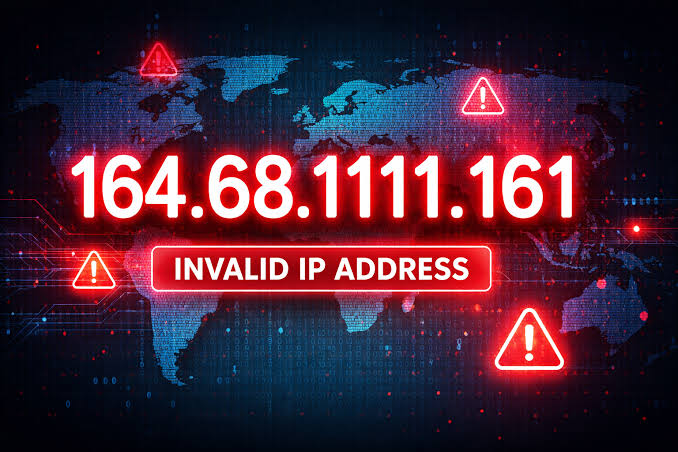
This is why an address like this cannot be pinged, geolocated, or traced to an owner. A lookup tool that returns details for it is either guessing or showing data for a different address.
The Most Likely Explanation: a Typo
When an invalid address shows up, the usual cause is a typing slip, often one repeated digit. The nearest valid candidate here is 164.68.111.161, which is the same address with one “1” removed. Other causes include:
- A copy-and-paste error from a spreadsheet or document.
- A script or log parser that joins fields incorrectly.
- Test data, since developers often use malformed values to check validation.
- A mistyped IPv6 or version number that was mistaken for an IPv4 address.
You can only call it a typo if you can trace where the string came from. The string alone doesn’t prove it.
What We Can Say About 164.68.111.161
Because the corrected address is syntactically valid, it is reasonable to ask who controls it. Registry-based sources list the range 164.68.96.0 to 164.68.127.255 under Contabo GmbH, a company based in Munich, Germany. A routing lookup for a neighbouring address in the same range shows AS51167 announcing the prefix 164.68.96.0/23 for Contabo GmbH. cesnethe
That tells you the block belongs to a hosting provider, not a home or office connection. It does not tell you what is running on 164.68.111.161 specifically, who rents it, or whether it has ever sent unwanted traffic. I could not verify any of that for this exact address, so treat it as unknown until you check a live source. Hosting ranges are shared among many customers and can be reassigned, so a clean or bad reputation for one address says little about its neighbours.
Is 164.68.1111.161 Dangerous?
The string itself cannot harm anything, because it points nowhere. What matters is the context where you found it. A malformed address in a log can come from:
- A logging or parsing bug.
- A misconfigured application.
- Automated scanners sending unusual input to see how a system handles it.
If it appears once, a typo is the simplest explanation. If it appears repeatedly, or next to failed logins or odd requests, look at the surrounding entries and the real source IP of those requests.
Beware of Pages That Treat Invalid Numbers as Real
Search for a malformed address and you will find pages that describe it as a “public IPv4 address” with “associated” owners and security details. A search I ran for a near variant with an impossible first block (264.68.111.161) returned several templated pages that made exactly this claim, with no actual owner data. Real information about an IP comes from registry records such as RIPE, ARIN, or APNIC, and from routing data. Pages that describe an invalid number as a real endpoint are not reliable.
How to Check What You Found
- Find the source. Note which log file, tool, or page contained the string, and the timestamp.
- Validate it. Run it through your language’s built-in IP parser or a validation tool. It will fail at the 1111 block.
- Test the likely correction. Look up 164.68.111.161 in a registry (WHOIS) tool and a reputation database, and treat the results as a snapshot.
- Check the surrounding events. Look at what happened before and after the entry, especially repeated attempts.
- Fix the cause. If a script produced the bad value, correct the parsing or input validation.
Why IP Validation Matters
Strict checking of IP addresses keeps routing, logging, and access rules working as intended. Weak validation can lead to misrouted requests, broken allow-lists, and filters that unusual input can slip past. Accepting only values in the 0–255 range for each octet, and exactly four octets, removes a whole class of avoidable mistakes.
Conclusion
164.68.1111.161 is not a valid IPv4 address, because 1111 is outside the 0–255 range. It is most often a typo, a parsing error, or test data. If you meant 164.68.111.161, that address sits in a block registered to Contabo GmbH, but its current use and reputation need a live check. Find where the string came from before drawing conclusions.
Is 164.68.1111.161 a valid IP address?
No. The third block, 1111, is above 255, which is the maximum for each IPv4 block.
Why can’t an IPv4 block be higher than 255?
Each block is 8 bits, which can represent only the numbers 0 to 255. A larger number does not fit.
What address did the person probably mean?
Possibly 164.68.111.161, which has one fewer “1”. This is an assumption, so confirm where the original string came from.
Who owns 164.68.111.161?
Registry-based sources list the surrounding range, 164.68.96.0 to 164.68.127.255, under Contabo GmbH, a hosting company in Munich. Check a live WHOIS tool for details on this exact address.
How can I check whether an IP address is valid?
Use a validation tool or your programming language’s built-in IP parser. It should reject any address with a block above 255 or with more or fewer than four blocks.
