
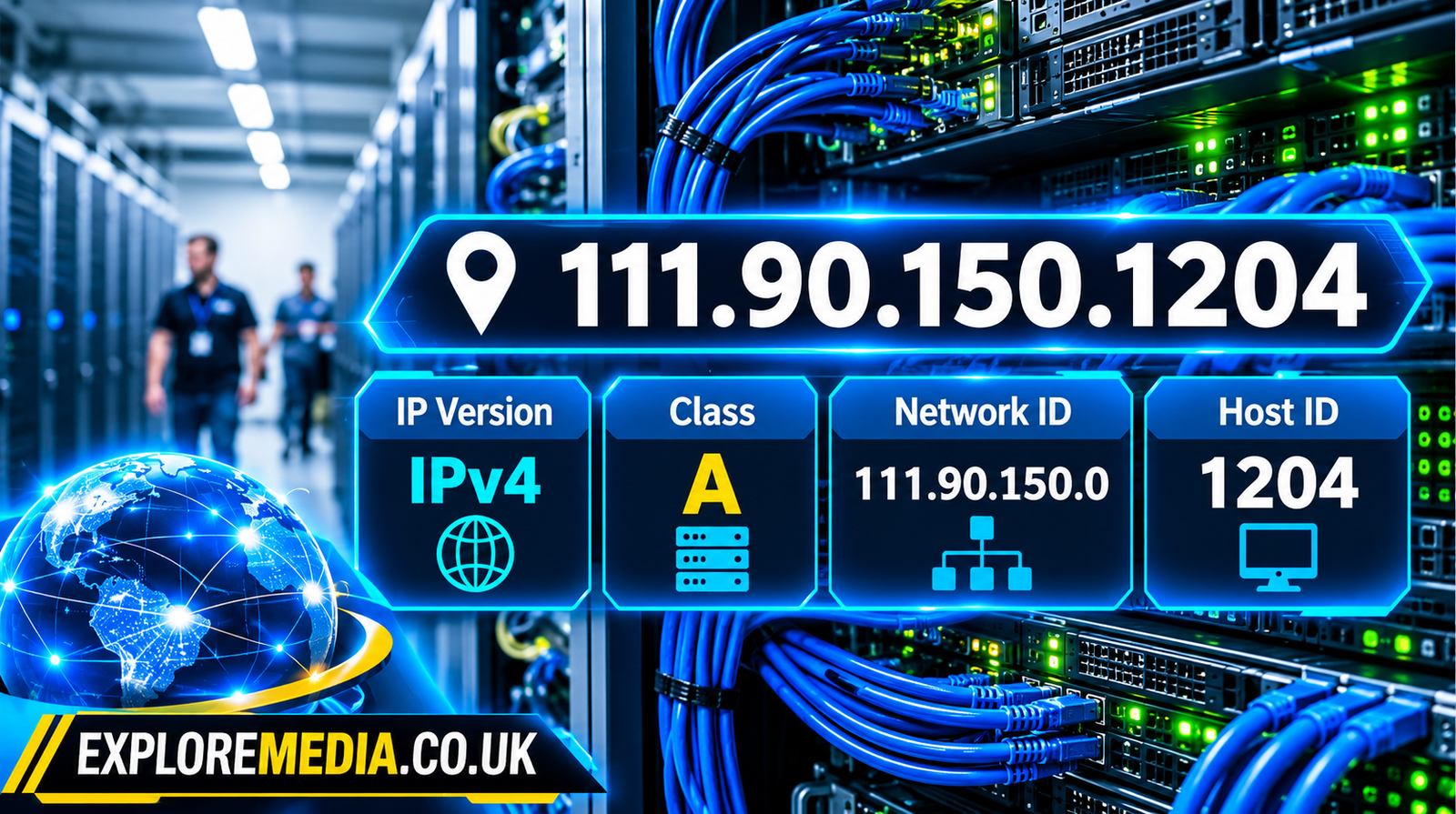
If you landed here after seeing 111.90.150.1204 in a log file, a browser bar, a message or a search result, you probably want a simple answer: what is it, and is it safe? The short version is that 111.90.150.1204 is not a valid IPv4 address, so it cannot point to a real device or server. This article explains why, what the number likely means, how it relates to the real network range it resembles, and what to do next.
Table of Contents
- What 111.90.150.1204 Means for Readers
- Why Is 111.90.150.1204 Not a Valid IP Address?
- Why People Search for This Address
- The Real Network Behind 111.90.150.x
- Is It Safe? Reading the Risk Honestly
- How to Find the Correct Address
- Frequently Asked Questions
- Conclusion
What 111.90.150.1204 Means for Readers
<a id=”what-1119015012040-means”></a>
An IPv4 address is made of four numbers separated by dots, and each number is called an octet. In 111.90.150.1204, the first three parts look normal: 111, 90 and 150. The problem is the last part, 1204, which is far larger than any octet is allowed to be.
For readers, that means this string is not a working address. It cannot be pinged, browsed to or traced to a specific machine. Whatever produced it, whether a typing mistake, a broken script or a copied snippet, did not give you a usable destination.
It still helps to read the string carefully, because the valid part carries some meaning. The first three numbers, 111.90.150, match a real address block, which is why the full string tends to look legitimate at a glance.
Why Is 111.90.150.1204 Not a Valid IP Address?
<a id=”why-invalid”></a>
Each octet in an IPv4 address holds eight bits of data. Eight bits can represent whole numbers from 0 to 255, and nothing higher. This is a basic rule of how IPv4 is built, and it applies to every address on the public internet and on private networks alike.
The last octet in 111.90.150.1204 is 1204. That is nearly five times the maximum of 255, so no router, browser or operating system will accept it as an address. If you type it into a ping tool or a browser, you should expect an error such as “invalid host” or “address not found” rather than a connection.
There are a few common ways an invalid number like this appears. A person may add an extra digit by accident, such as typing 1204 where 120 or 204 was intended. A copy-and-paste may merge two numbers. A script or template may also build an address by joining values without checking them. In all of these cases the string is a mistake, not a hidden address, and there is no reliable way to know which valid address was meant.
Why People Search for This Address
<a id=”why-people-search”></a>
People usually end up searching for a string like this for practical reasons. The most common is finding it somewhere unexpected: in a server log, a firewall alert, an email, an analytics report or a link they were sent. When something looks like an IP address but behaves strangely, searching it is a natural first step.
Another reason is curiosity about what the address would reveal. Many people assume any four-part number maps to an owner, a location or a website. Searching helps them find out whether the address is real, who runs it and whether it is a threat.
A third reason is security worry. Unfamiliar addresses in logs can look alarming, and invalid ones raise extra questions. The reassuring part is that an impossible address cannot itself connect to your system, because no device can use it. The more useful question is where the string came from, and that is covered below.
The Real Network Behind 111.90.150.x
While 111.90.150.1204 is not real, the block it resembles is. Public registry data shows that the range 111.90.128.0 to 111.90.159.255 is registered under the network name SHINJIRU-MY to Shinjiru Technology Sdn Bhd in Malaysia, and that the 111.90.150.0/24 route is originated by AS45839, also Shinjiru Technology. A lookup of a neighbouring address in the same range, 111.90.150.20, places it in Klang, Malaysia, under the Shinjiru domain.
In plain terms, valid addresses that begin with 111.90.150 belong to a Malaysian hosting and internet services company. That does not tell you anything about 111.90.150.1204 itself, because that address does not exist. It only explains what the readable prefix points toward.
It also helps to know what a hosting range means. Hosting companies rent servers and addresses to many different customers, so one address in a range can be used by a harmless business site while another is used by someone else entirely. The owner of the range is not the same as the person running a particular service on one address.
Is It Safe? Reading the Risk Honestly
The invalid address itself is not dangerous, because it cannot be reached. But the context in which you found it matters, and that is where caution is useful.
Some real addresses in the nearby range have appeared in security databases. For example, one security database lists the nearby address 111.90.150.83 as having hosted a malware download in March 2022, with the entry marked offline. Other threat-intelligence pages record a different neighbour, 111.90.150.174, as noticed once for SSH-related activity and scored low, while stressing that such scores are historical and indicative only and should not be treated as an accurate picture of the network behind them.
These findings should be read carefully. They show that addresses in a shared hosting range can be used for many purposes, including bad ones, but they do not mean the whole range is unsafe, and they say nothing about 111.90.150.1204. The sensible approach is to avoid guessing which real address was intended, avoid clicking links that contain it, and check the source that showed it to you.
How to Find the Correct Address
If you were trying to reach a real device or server, start by checking where the number came from. Go back to the original message, configuration file or log line and look for a typing error. A last octet of 1204 might have been meant as 120, 204 or something else, and only the original source can settle that.
If the string appeared in a log or alert, treat it as a data quality problem first. A properly working system should not record an impossible address, so the cause may be a faulty script, a mis-parsed log or a person editing a file by hand. Fixing the source of the bad value is more useful than trying to trace the address.
If it came in a link, email or message you did not expect, do not open it. A string that looks like an address but is not valid is a poor sign for a genuine message. You can check a real address using a reputable IP lookup service, but only after you have confirmed it is valid, meaning every octet is between 0 and 255. When in doubt, ask the person or system that supplied it to confirm the correct value.
Frequently Asked Questions
Is 111.90.150.1204 a real IP address?
No. IPv4 octets can only range from 0 to 255, and 1204 is outside that range, so the address cannot exist.
Can 111.90.150.1204 hack or track me?
The invalid address itself cannot connect to anything, so it cannot hack or track you. If it appeared inside a suspicious message or link, the message is the thing to be careful about.
Who owns 111.90.150.1204?
Nobody, because it is not a valid address. The similar range 111.90.150.0/24 is registered to Shinjiru Technology Sdn Bhd in Malaysia, but that applies only to valid addresses in that block. 111.90.150.1204
What should I do if I found it in my server logs?
Check the logging source for errors or manual edits. A valid server should not record an impossible address, so it is worth reviewing the script or parser that produced it.
How can I check whether an IP address is valid?
Make sure it has four numbers separated by dots and that each number is between 0 and 255. Anything outside that range is not a valid IPv4 address.
Conclusion
111.90.150.1204 is not a real IP address, because its final number is larger than the 255 limit that every IPv4 octet must respect. That means it cannot lead to a server, a device or an owner, and it cannot do anything to your system on its own.
The readable beginning, 111.90.150, does match a real block registered to a Malaysian hosting company, which is why the string looks believable. Even so, nearby addresses show only that shared hosting ranges can contain a mix of uses, not that this particular string is connected to any of them.
The practical takeaway is simple: do not try to guess the intended address, trace the source of the string, and treat any unexpected message containing it with caution. If you can find the original value, check it against the 0 to 255 rule before running any lookup.
READ MORE: https://exploremedia.co.uk/

1 Comment
Pingback: 212.32.226.324 - Explore Media